18 February 2012

Attacking the Arts


The conservative mindset assigns value in terms of economic price. In its worldview, NFL football, NASCAR, and professional wrestling are more worthy cultural institutions than art museums, symphonies, and poetry readings because the former generate more revenue. In fact, the arts are often seen as serving a sinister purpose: they promote a “left wing agenda” or “moral decay” as exemplified by the hysterical reactions to the photographs of Robert Mapplethorpe or works like August Seranno's “Piss Christ.” As a result, conservative forces are constantly at war with the concept that there should be public funding of the arts.

It is in this context that Governor Scott has launched the latest right wing assault on the humanities in the form of higher education reform. He has proposed that university curricula be funded on the basis of economic worth – more specifically, on the job prospects of a graduate from a given program. It is his belief that gaining employment is the only conceivable reason for a person to obtain an education and the only justification for the public to finance that education. The idea of “learning for learning's sake” is an outmoded one; a person's worth is to be determined solely by his or her ability to earn money and to be a efficient cog in the corporate machine.

This campaign of Scott's is sad, but not surprising. We have long since abandoned the concept of the classical education; the trend toward mediocrity is nothing new. The very idea that a university graduate should have a basic understanding of multiple disciplines including both the arts and the sciences is no longer current; cost-cutters seek to reduce spending for services like education (usually in order to give tax breaks to wealthy corporations) and those ways often include decreasing general education requirements. It is no wonder that even supposedly “educated” citizens often fail to grasp the cultural importance of the humanities. As a result real artists struggle to survive while marketers like Thomas Kinkade earn millions selling worthless garbage in shopping mall “galleries.” But then, hucksters like Kinkade are the perfect source of decoration for conservative America: vapid, non-threatening, and devoid of intellectual content.

Of course, it is not only the fine arts which are drawing the Governor's attention; the social sciences are being threatened as well. History, anthropology, and the rest are nothing more than a waste of taxpayer's money according to Scott and his cronies. So much for Jefferson's idea of the “enlightened populace;” in today's world, the only rule is that of the marketplace. And that marketplace is demanding a labor force which is compliant, narrowly-focused, and unfettered by unnecessary knowledge. After all – a worker who is ignorant of the history of 20th century labor movement is less likely to support an effort to unionize a company's workforce.

This notion that the primary purpose of education is to train workers is just another example of the dehumanization being advanced by the corporatist state. It is a difficult idea to resist in an economic climate such as the current one; when citizens are unable to find adequate employment and wages are shrinking, they are easily bullied. But if we are to maintain an environment in which the arts are allowed to flourish, we must find a way to counter the efforts of conservatives like Governor Scott. We must continue to fund and support efforts like the National Endowment for the Arts, and to provide educational opportunities to artists of all types. It is obscene to pour millions of dollars into postsecondary athletics while at the same time stripping fine and liberal arts departments of their ability to produce properly educated graduates.

26 November 2011

Power to the People, Part Three


After the killings at Kent State and Jackson State, there were more local demonstrations. During my senior year at high school, I continued to work on the student newspaper; I was even the co-editor for a semester. I was somewhat aware of what was going on nationally with SDS, but did not know much of the story until later. The increasing willingness of the government (at all levels) to use force to quell anti-war protests had provoked a belief on the part of many involved in the movement that a violent response was called for. SDS had fragmented into two separate factions, one of which was the Weatherman group which advocated cultural, as well as political, revolution. The division would eventually lead to the dissolution of SDS which had been the largest campus-based political movement in U.S. history. The first major action by Weatherman had been the Chicago Days of Rage in the late fall of 1969 during which demonstrators openly battled with the police. The event did not go as planned; only a fraction of the expected number actually turned out and the Black Panthers, with whom Weatherman was actively seeking an alliance, publicly disassociated themselves from the protest.

Less than two months later, the charismatic Panther leader, Fred Hampton was murdered in his sleep by a team of Federal agents and Chicago police officers. This only confirmed to Weatherman that peaceful protest was ineffective, that they were at war with the government. A guiding principle of the group was that to stand idly by while acts of violence were being waged by one's government (and, by extension, in one's name) was an act of violence in and of itself. A plan was developed to begin bombing government targets, a decision which was to have a tragic result; in March, 1970 three members of the group were killed by an accidental explosion in a Greenwich Village townhouse owned by one of the members' family. Diane Oughton, Ted Gold, and Terry Robbins were killed; Cathy Wilkerson and Kathy Boudin escaped without injury. The accident led to a re-evaluation of the group's strategy; it was determined that only property damage was acceptable and that all measures to prevent loss of life were to be taken. Those measures were successful; the only people to die as a result of Weatherman bombs were three of their own members. In effect, Weatherman bombings were acts of vandalism staged as political theater - not any sort of terrorism as some have alleged. The fact of the matter is that the Ohio National Guard killed more innocent victims in one day than Weatherman did in its entire six year history. One does not have to support the group's tactics (and I did not) to see the irony in this truth. Still, the strategies developed by Weatherman/the Weather Underground were flawed, however as member Brian Flanagan noted in a 2002 documentary, "when you feel you have right on your side, you can do some horrific things."


The following school year was punctuated with more anti-war protests and the beginning of a local underground newspaper, the Gulf Coast Fish Cheer, which was published by a group of university and junior college students. Perhaps the crescendo of the year (politically, at least) was the Festival of Life held in April at UWF which brought Chicago Seven defendant Jerry Rubin and fellow Yippee Stewart Alpert to Pensacola. Their appearance caused quite a stir; the university was closed to all but students and faculty members. I suppose they were afraid of a full-fledged riot breaking out, but those worries were groundless. I managed to borrow someone's UWF student ID (they didn't have pictures then) and got on campus to hear the speeches. The only thing I remember from the speeches was Rubin calling for Richard Nixon and Lt. William Calley (of My Lai massacre notoriety) to be tried as war criminals - a sentiment with which I fully agreed.

In 1972, I supported George McGovern for the Democratic nomination and was pleased when he won. The ensuing campaign would prove to be inept of course and Nixon coasted to a landslide victory. I suppose that we had the last laugh when his Presidency was reduced to a shambles by the Watergate scandal and his subsequent impeachment. His successor would prove to be little more than a placeholder, even in the face of the major events that occurred during his term. The US involvement in Indochina came to an end and the country was plunged into the worst recession in forty years, but the government was paralyzed and unable to act. The result was that Ford lost the 1976 election to Jimmy Carter, a leader in whom many on the liberal side invested a great deal of hope. His presidency was also the victim of world events and the dissatisfaction among the American people resulted in the 1980 election of Ronald Reagan, an affable right winger who would do untold damage to the country and inaugurate a thirty-year reign by conservatives. The destruction resulting from those three decades has literally brought the country to the precipice; income disparity, environmental damage, pointless wars are the legacy of the era which began in 1980. There may be some hope that this conservative period has finally run its course, but we should remember that a wounded beast is often the most dangerous when in its death throes. There is little doubt that we are in the twilight of the period which began with the election of Reagan, but the recovery will be painful and will take many years to effect. We can all have a good laugh at the clownishness of the modern conservative movement, but they have yet to be defeated; the battle continues. The fact that we will almost certainly prevail in the end may be small comfort during the suffering that may yet have to be endured.

The legacy of the Sixties Movement is significant. It gave rise to later efforts to achieve equal rights for women, gays, and Native Americans, as well as to the modern environmental movement. Perhaps its greatest shortcoming was the antiwar movement's inability to come together with labor groups and working class citizens, a failure which is understandable given the relative prosperity of the period. Furthermore many union members and blue collar workers, as veterans and survivors of the Second World War, were not ready to give up on their convictions that the foreign policy of the United States was a force for freedom and good in the world. In those days, a working class parent still could hope that his or her children would be able to have a better life; the so-called "American Dream" was still part of of the dominant mythology. Of course the ensuing conservative era would deal a series of blows to that mythology which have proved fatal, opening new opportunities for the Left and giving reason to hope that a truly equitable and just society will eventually become a reality. The struggles of the Sixties were not in vain; they resulted in great victories in the fight for civil rights, they destroyed two Presidencies, and ultimately, they ended an unjust war. No doubt there was progress made, but the struggle goes on; ultimate victory will be our destiny if we will but fight for it.

05 November 2011

Power to the People, Part Two


In the fall of 1969, I changed schools. My new school had been a segregated, all-black institution, Booker T. Washington Senior High. Once again, as I made new friends, I found a few students who, like myself, were supportive of the anti-war movement. I also managed to join the staff of the school newspaper as an editorial writer; my first column was (you guessed it) a call for an end to the American involvement in Vietnam. That fall, I participated in my first anti-war demonstration which was part of the national (actually international) Moratorium to End the War in Vietnam.

My life changed one weekend when my friend Doug suggested that we go to The Establishment, a local coffeehouse located near the University of West Florida. I soon began going there every Friday and Saturday night; it was pretty much the only place I went on weekends. I got to know a few UWF students there, including David Goff and his wife Karen who lived in the house next door and managed the coffeehouse. They were amazingly tolerant of a young high school student who shared their political views; but, more importantly they, along with a few other students from the university, were looking for ways to become more involved in the movement that was sweeping the country.

Over the next few months more people drifted into our circle, including Dr. Alan Kirshner, a UWF History professor who became a mentor to our group. He recommended that we form an official organization which would serve as a clearinghouse for protest activities in Pensacola. And so the unfortunately-named Survivalist Coordinating Committee was born with the goal of working to link students from the university, the junior college, and local high schools with like-minded members of the community. We were especially interested in connecting with Pensacola's civil rights organizations. It should be noted, by the way, that the term "survivalist" did not have the same meaning then as it would years later. Our idea was that change was going to be required if our society was to continue and grow.


Our attempts to form liaisons with the various community organizations were not overly successful; however I did have experience of meeting several of Pensacola's foremost civil rights organizers, most notably the Reverend H. K. Matthews. It seems strange, given the respect and honor that is accorded Rev. Matthews today; in 1969 he was regarded as a dangerous radical by the white community. But he was probably the most important civil rights leader of his day in Northwest Florida and was (and is) a truly great man. Even today as a man in his mid-eighties he is active; he recently visited the Occupy Pensacola group and let them know that he was willing to occupy the park with them if needed. As I said - a truly great man who has spent his life dedicated to the pursuit of social justice.

That spring, the S.C.C.'s focus turned to environmental issues. April 22 of that year was the first Earth Day and I was able to organize an assembly at my high school to mark the event. I arranged for two UWF professors to speak at the assembly: a biologist and Dr. Kirshner. Alan's remarks at that gathering were to have far-reaching effects. He had already gotten the attention of some powerful individuals in the community by speaking at local anti-war rallies, but his remarks at Washington High School that day would eventually cost him his job.

Alan's speech that day was relatively mild, but it did not go over well with some members of the school's administration. That was ironic, because the line that created the strongest reaction was actually complementary to the school's principal, Neroy Anderson. Alan praised Mr. Anderson, saying that he was a man more interested in what was inside his students' heads rather than what was on top of those heads (referring to his toleration of males wearing long hair). The students' reaction was overwhelmingly positive and it seemed that the assembly had been a great success. Later on, however, word came down from the County Superintendent's office that his speech at the assembly had been geared to incite a riot (ignoring the fact that absolutely nothing of the sort had occurred). They declared Alan persona non grata and banned him from setting foot on county school property. This presented a problem as one of Alan's job responsibilities was to supervise student teachers from the History Department. Pressure grew - once again from powerful interests in the community - to fire him and several other faculty members who were perceived as dangerous radicals. Eventually that is exactly what happened; Alan appealed to the Board of Regents to be reinstated, but that appeal was denied. I testified during his hearing that there had been no adverse reaction, but the Board decided to defer to the School Board and denied the appeal. Alan quickly got another teaching job at a school in California, a position which he held until his retirement in 2011.

I will never know exactly what the real circumstances leading to Alan's termination were; that is, who actually was responsible for his banishment from county school property. I do believe that Mr. Anderson was basically a good man however, so my best guess is that it came from some community leaders and the county administration. Alan was not the only leftist professor to be let go; another had lost her job for making a speech to a Rotary Club which was not well-received. I suppose that if one was going to make a left-leaning political speech in those days, a Rotary Club in Pensacola, Florida was a dangerous venue to choose.


Less than two weeks after that first Earth Day, the war was suddenly at the forefront again. On April 30, Richard Nixon announced the invasion of Cambodia, sparking outrage and intensifying protests on American campuses. It was at one of those protests that four students were killed by the Ohio National Guard at Kent State. Four days later, eleven students were bayonetted by the New Mexico National Guard during a protest at the University of New Mexico. Fortunately, none of those students were killed, but two students at Jackson State were not so lucky on May 14, when they were shot and killed in a similar fashion as those at Kent State. The United States, under the leadership of the Nixon Administration, had declared war on its own children.

26 October 2011

Power to the People, Part One


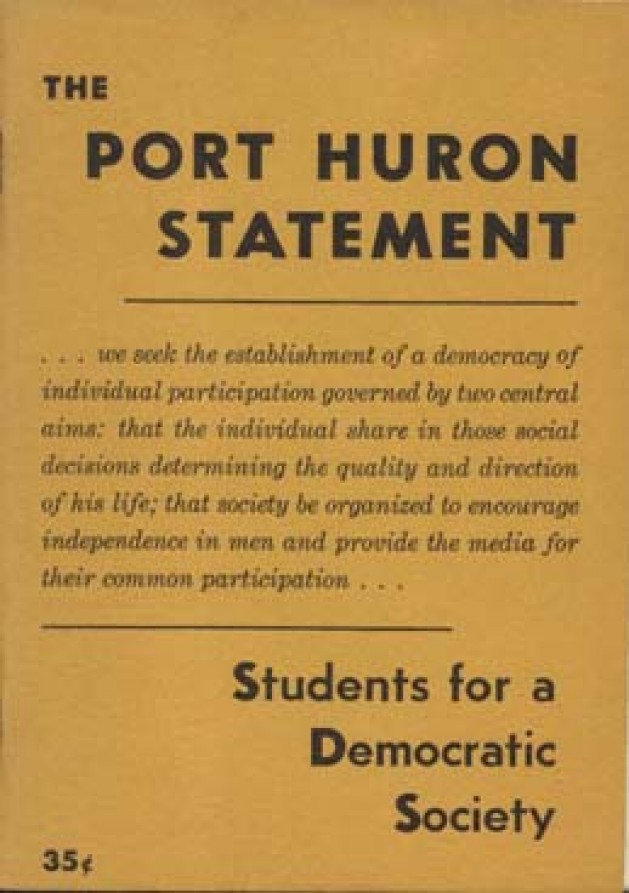
The fires of activism are burning again. The Occupy Wall Street protests may be the beginning of a new era of political action by a long dormant American Left. It is in that context that these reflections are written. I can only hope that the movement inspired by OWS is real and lasting...

"We are the people of this generation, bred in at least modest comfort, housed now in universities, looking uncomfortably to the world we inherit" - Port Huron Statement of the Students for a Democratic Society, 1962

I was born in 1953 - just months after Dwight Eisenhower began his first term as President of the United States. My earliest awareness of politics came with the election of 1960. I was only seven years old and knew nothing of the issues of that day, but I liked John Kennedy. Compared to the grandfatherly Eisenhower, he was young and vibrant - from the same generation as my parents. I dimly recall that his election seemed to mark a new beginning - but I didn't know why. Growing up in Atlanta, I saw the separate drinking fountains and attended a segregated school (until the 6th grade) and even at that young age I had a sense that the treatment of African-Americans was brutally unfair. But I was a child and had only a child's perceptions of the world I lived in.

My memory of the Cuban Missile Crisis of 1962 is of my Mother telling me that we would have to watch the President speak on television one night to see if "the soldiers were going to go to war." My fear was for my Father; I was terrified that he was going to have to leave our home and fight. Fortunately was averted, although it was years before most people realized just how close we came to a nuclear confrontation with the Soviet Union.

The Kennedy Administration was, sad to say, all too short-lived. In November 1963, I was sitting in my fifth grade classroom when the school principal announced on the intercom that the President had been shot in Dallas. A few minutes later a second announcement came - the dreaded news that John F. Kennedy was dead. School was dismissed early and for the next four days I watched events unfold on my family's black and white television. I actually saw the shooting of Lee Harvey Oswald live on the news as our family sat eating lunch. My Father simply said, "My God." The whole world seemed to have gone mad in this terrible and frightening time that marked the beginning of the period we now call "the sixties."

Lyndon Johnson assumed office and immediately began to press for passage of Kennedy's Civil Rights legislative agenda. By the end of 1964, the Civil Rights Act was law to be followed the next year by the Voting Rights Act and the Social Security Act of 1965 which established Medicare, a cornerstone of Johnson's ambitious Great Society program. These accomplishments should have established the Johnson Administration as one of the great presidencies in American History. But, in 1964 another bill was passed which would overshadow LBJ's social agenda and eventually destroy his presidency: the Gulf of Tonkin Resolution which began the escalation of America's involvement in Vietnam. Over the next few years, S.D.S. and the student movement gradually refocused its attention from Civil Rights and Nuclear Disarmament to the organized opposition to the War in Vietnam and set the stage for the explosive events of 1968.

By 1968, Vietnam dominated the American consciousness, especially on college campuses. On the last day of January, the Tet Offensive began - which led to two key media events which would begin to turn American public opinion against the war. The first was the publication of the famous, Pulitzer Prize winning photograph by Eddie Adams depicting the summary execution of a Viet Cong officer by a Saigon police official. The second was the February report on the war by Walter Cronkite in which he declared his opposition to America's involvement in the war. One month later, Lyndon Johnson announced that he would not seek re-election and the race for the Democratic nomination became a three-way race between Hubert Humphrey, Eugene McCarthy, and Robert Kennedy.

Despite the focus on the war, the Civil Rights movement was still very active. Its primary leader, Martin Luther King had begun to expand his focus to broader issues, recognizing that people could not live in freedom when they were oppressed economically. It was that economic oppression that brought him to Memphis in early April to support a strike by African American sanitation workers. That work was brutally cut short when he was assassinated on April 4. I was in the ninth grade that year and was a member of my high school's tennis team. We were to have practice the next day, but it was canceled, not out of respect for Dr. King, but because of the rumors that there was going to be "trouble."

Two months later, I was camping out with two friends when a third friend came to visit us. He gave us the news that Robert Kennedy has been shot the night before in California. We were stunned - but not as much as one might think. to our young minds, this was becoming the status quo - people who worked to make a difference politically were (it seemed) routinely gunned down in the United States. I can't say that the event had any immediate effect on my political views; it was simply too commonplace then. It retrospect, the loss of Robert Kennedy was a turning point for me and for many. Even today - 43 years later - there are many on the Left who think his assassination changed the course of history. Would we have suffered through the Nixon presidency had Kennedy gotten the Democratic nomination that year? Would we have suffered through a thirty-year conservative reign later on? No one will ever know.

What did have a profound and immediate effect on my politics that summer was the police riot that occurred outside of the Democratic Convention in Chicago. The images on television were dreadful and there was absolutely no question which side I was on. I can say that my radicalization really began that week; it was then that I began to realize that the promises of American freedom of expression and the right to political dissent were not guaranteed by the political system. In fact, the political system seemed intent on suppressing those rights whenever it could. That, by the way, is still true to this day; the powerful corporate interests that control our nation are intent on using their resources to quash any action which threatens their power. More on that later.

In November of that year, my family moved to Pensacola. As I began to make new friends, I gravitated to students who, like myself, were sympathetic to the anti-war movement. Pensacola was (and is) a conservative town so there was very little in the way of organized protest in 1968. Over the next few years, that would change, however.

24 May 2010

O Lost

"O lost, And by the wind grieved, Ghost,
Come back again.
" - Thomas Wolfe

Commercial Television sometimes makes for too easy a target. Series abound with poor writing, hackneyed themes, and mediocre acting. The commercial medium presents a challenging structure: David Lynch described it as making a series of short, self-contained subfilms, 10-15 minutes long and separated by mostly annoying distractions. The requirement of high ratings exacerbates the problem as Americans are generally not overly sophisticated in their entertainment choices.

And yet - sometimes a project develops which is able to transcend the limitations of the form. Commercial television has seen its greatness - The Twilight Zone, The Prisoner, China Beach, The Wonder Years, Buffy the Vampire Slayer, and the re-imagined Battlestar Galactica (okay it was cable, but still had commercial interruptions) to name a few of the dramas. We can add Lost to that mix; for the past half-decade it has been the best thing on network TV. It had an ingenuous premise to be sure with all sorts of twists, turns, and clever cultural allusions. But ultimately, the great dramatic shows are about characters and JJ Abrams gave us some great ones. Last night's finale was a teary event - each realization/flashback reinforced our love for these characters. The episode was remarkably artifice-free, the writers simply gave us the straight story - no final twist or curve ball. All of our questions weren't answered of course (no one really expected that did they?) but we saw the people we have come to know and care about reach resolution and redemption.

Lost was ultimately about hope after all.

14 January 2010

RIP Teddy

Philadelphia soul never got any better than this.

23 October 2009

Sincerely, L. Cohen


We're so lucky to be alive at the same time Leonard Cohen is.
- Lou Reed inducting Leonard Cohen into the Rock and Roll Hall of Fame 2008

Another night, another capacity crowd, another standing ovation as the old man takes the stage. He humbly thanks the audience and then it begins:

Dance me to your beauty with a burning violin
Dance me through the panic til Im gathered safely in
Lift me like an olive branch and be my homeward dove
Dance me to the end of love...


The same song with which he began his shows the last time he toured - 15 years ago. His voice is rough and weathered and deep, and it fills the theater. After the ovation for the song, he removes his hat, holds it over his heart, and thanks the audience, telling them that "I don't know when we might pass this way again, but tonight we are going to give you everything we have." And for the next three and a half hours, that is what he and his compatriots did, giving the audience a 25 song overview of a career which has lasted more than 50 years (his first book of poetry was published in 1956). There were songs from every period; the setlist drew the most from 1988's "I'm Your Man" - featuring 6 songs from that album - but the material ranged from "Suzanne" and "Sisters of Mercy" right up to the sublime "In My Secret Life." All of this performed with a virtuoso band and vocal support from his long-time collaborator Sharon Robinson along with Hattie and Charley, the Webb sisters.

The high point of the show for many (I'm sure) was "Hallelujah" - perhaps Cohen's best-known song these days. And it was a stirring performance - reminding the audience that, while Jeff Buckley and Rufus Wainwright may have popularized it, Cohen owns this song and no one - no one - will ever sing it like he does. It was a great moment to be sure - but for me, the second encore (there were three) was the highlight with a sparse performance of "Famous Blue Raincoat," followed by "If It Be Your Will." The latter opened with a recitation by Cohen after which the Webb sisters sang the rest of the song.

So - the three hours plus was a gift from this great artist - poet, novelist, songwriter, Zen monk, performer, mystic - to the audience. It is likely that most of us will never again have the opportunity to see this music performed live: Cohen is 75 and one has to wonder if he will be able to mount an effort like this again. Sooner or later, the song will prove prophetic:

If it be your will
That I speak no more
And my voice be still
As it was before
I will speak no more
I shall abide until
I am spoken for
If it be your will


We are indeed fortunate to have Leonard Cohen: I have never seen a performer with such dignity, class, and humility, and genuine love for his audience. This was the concert experience of a lifetime for me and I will treasure the memory.

Photo credit: Robb Cohen

16 September 2009

Pawns in the Game


A South politician preaches to the poor white man
"You got more than blacks, don't complain
You're better than them, you been born with white skin" they explain
And the Negro's name
Is used it is plain
For the politician's gain
As he rises to fame
And the poor white remains
On the caboose of the train
But it ain't him to blame
He's only a pawn in their game.

- Bob Dylan "Only a Pawn in Their Game"

Former President Carter's comments with respect to race and President Obama's oppostion are, regrettably, dead on - at least in the South. This is not to say that all opposition (Southern or otherwise) to the Administration's policies is motivated by racism. Carter didn't say that; what he said was that the most vehement, hateful opposition had a significant racial component. Maureen Dowd wrote essentially the same thing in Sunday's New York Times.

Conservative officials send and forward ethnically-demeaning emails - pictures of watermelon patches at the White House, portraits of the 43rd President as a pair of white eyes in an otherwise black frame, pictures of the President dressed as an African witch doctor or as Curious George - the list goes on. Underlying the so-called birther's contentions regarding the President's citizenship is the bigoted fear of the other - the exotic - the foreign - the un-American. There are to be sure a number of Americans - and the vast majority of them are in the South - who simply cannot accept the fact that a non-white person could be the Commander-in-Chief. Not all southerners - not even most southerners. But they are there. Some of them I know - some I have known all of my life.

Glen Beck is probably the prominent journalist to flirt with overt racism - his accusation that the President "hated white people" was a play to those in his audience who wanted their own bigotry and hatred rationalized and made legitimate. Pat Buchanan writes longingly of the days when when Jeb Stuart and Robert E. Lee were viewed as heroes (instead of the traitors that they most certainly were), and laments that Dr. King and Cesar Chavez have taken their place in the American pantheon. Rep. Joe Wilson - with a history of association with neo-confederate organizations - shouts out at the President, "you lie" and those of us who know the South could almost hear the "boy" which would have followed in less august surroundings. And the weekend "Tea Party" demonstration in Washington, DC - which glorified the aforementioned Beck and displayed numerous racist signs and placards - resembled nothing so much as an old-fashioned lynch mob. The only thing missing was the rope - at least, I didn't see a rope in any of the pictures (there might well have been one there).

The election of President Obama has picked a scab from a national wound - and, while they will not outwardly condone overt racism, the conservative leadership recognizes the fact that bigots represent a small, but significant portion of their following. Their titular leader - Rush Limbaugh - has known this for years and racially-offensive humor has been a part of his routine from the beginning. Even the election of the embarrassingly incompetent Michael Steele to the RNC chair was little more than a callous and cynical attempt to cloak that aspect of the right wing. But - in the final analysis - the Republicans have only the White South remaining as a base - and they cannot afford to antagonize any of their remaining constituencies. So they don't.

Fueling the fire further is the demographic holocaust which is beginning to engulf the conservative movement. American whites are well on their way to minority status; this is the real reason behind the vitriol directed at citizens of African or Hispanic descent. Before all is said and done, Asians will likely join other non-white people as objects of suspicion. There are still some dark days ahead - but we recognize that these issues have to be exposed to the light of day. And the offenders will run from that light like the cockroaches they are.

11 September 2009


"I never meant to say that the Conservatives are generally stupid. I meant to say that stupid people are generally Conservative. I believe that is so obviously and universally admitted a principle that I hardly think any gentleman will deny it."

- John Stuart Mill

28 August 2009

The Morse Code of the Gods


That's what one reviewer called Hal Blaine's drum riff in "Be My Baby." Brian Wilson called this the "greatest pop record ever made." Certainly a lot of that had to do with the earth-shaking wall of sound that Phil Spector imparted onto this production (and many others in the early 60's). And then - there's Veronica Bennett (later to become Ronnie Spector) whose eyes and voice were, and still are, mesmerizing. Watch her as she sings the line "we'll make 'em turn their heads" - she was unearthly.

And the song. The song was written by Jeff Barry and Ellie Greenwich who passed away this week at the age of 68. Greenwich was one of the Brill Building songwriters and she wrote many of the true classics from this period: "I Can Hear Music," "Baby, I Love You," "River Deep, Mountain High," "Da Doo Ron Ron," "Chapel of Love," "Leader of the Pack" - an amazing body of work which literally defined the early girl group sound and formed the basis for the great mini-symphonies that Phil Spector created for Philles Records.

But it didn't get any better than this - "Be My Baby" is timeless and capable of inducing goosebumps nearly a half-century later. It is, in a word, perfect. RIP Ellie.

26 August 2009

Band of Brothers

Less than a year ago, I visited Dealey Plaza in Dallas - the scene of the JFK assassination. It was just a week before the 2008 election and I was (and continue to be) one of those who believed that Barack Obama would be the one to continue the work that Jack - and later Bobby - had taken up decades ago. Now that the last of the Kennedy brothers has left, one can't help but reflect on how profoundly has this family has shaped American history and American politics. We remember hearing the news about JFK which changed our world forever - and then, less than five years later having our hopes dashed with the death of RFK. It was left to Ted to carry on the legacy - and carry it on he did. Of course he was human - and as such, an imperfect vessel - but he never gave up, never stopped trying to make his country a better, more civilized place to live. And for that, he deserves our respect and our gratitude.

"He mastered the tides of Nature with a look:
He met with his bare spirit naked Hell."
- Savitri, Book II, Canto VII

19 August 2009

Putting Away Childish Things

So - Grassley slipped up and told the truth - that he and the Republicans won't vote for Health Care Reform regardless of the concessions received. So be it. It's time to stop wasting our time with these weasels: the Democrats should go it alone and pass health care reform through the Reconciliation process (which circumvents the filibuster and the 60 vote requirement). Enough of being called nazis, communists, anti-american - whatever. Enough of these whackos with loaded weapons in the vicinity of the President: every one of them needs to be locked up. Enough.

In his Inaugural Address, the President said that it was time to put away childish things. And so it is. We have let this go way too far - remember the words of the Republicans in 2004: "elections have consequences." Let them scream and wail and gnash their teeth: not a single one of them is ever going to support the President anyway. They have removed themselves from the equation by refusing to take a constructive part in the debate.

14 August 2009

Sri Aurobindo b. 15 August 1872


"I had no urge toward spirituality in me, I developed spirituality. I was incapable of understanding metaphysics, I developed into a philosopher. I had no eye for painting -- I developed it by Yoga. I transformed my nature from what it was to what it was not. I did it by a special manner, not by a miracle and I did it to show what could be done and how it could be done. I did not do it out of any personal necessity of my own or by a miracle without any process. I say that if it is not so, then my Yoga is useless and my life was a mistake -- a mere absurd freak of Nature without meaning or consequence. You all seem to think it a great compliment to me to say that what I have done has no meaning for anybody except myself -- it is the most damaging criticism on my work that could be made. I also did not do it by myself, if you mean by myself the Aurobindo that was. He did it by the help of Krishna and the Divine Shakti. I had help from human sources also."

"I see that you have persisted in giving a biography -- is it really necessary or useful? The attempt is bound to be a failure, because neither you nor anyone else knows anything at all of my life; it has not been on the surface for men to see."

"The one aim of [my] yoga is an inner self-development by which each one who follows it can in time discover the One Self in all and evolve a higher consciousness than the mental, a spiritual and supramental consciousness which will transform and divinize human nature."

- quotes from Sri Aurobindo On Himself, Volume 26 Sri Aurobindo Centennary Library. Photo by Henri Cartier-Bresson

12 August 2009

Peter Pan and the Breakfast Club

Molly Ringwald's touching tribute to the late John Hughes hit a chord with me. There is no question that his films went a long way towards shaping the popular culture of the early 80's - something for which some might find condemnation rather than praise appropriate. But films like "The Breakfast Club" and "Sixteen Candles" were bittersweet gems which impacted millions of Gen-Xers - and some of us boomers as well. Some of my more astute film connoisseur friends might look down on this sort of thing, but the fact is John Hughes' work touched millions of lives - they gave adolescents a model and a vent in the dreary Reagan era. How many kids (now adults) look back on those films and say "that movie got me through high school?"

We boomers don't really understand what those 80's kids went through - and we sure as hell can't grasp what the millennials are dealing with now. But these are the ones who are going to have to fix the mess that people my age have created. They are going to have to deal with the environmental devastation, the increasing unavailability of basic services, and the outlook for a less prosperous life than the generations which preceded them. No wonder they're cynical and suspicious of their elders and the institutions which have been handed down to them.

And what do we - those elders do? We selfishly fight for our short term interests - mindless of the mess we have created and continue to create. The words of Alison from the Breakfast Club were sadly prophetic for too many of us - "when you grow up - your heart dies."

05 August 2009

Nothing Is Done Until Everything is Done


In the old Chaldean tradition, very often the young novices were given an image when they were invested with the white robe; they were told: "Do not try to remove the stains one by one, the whole robe must be purified." Do not try to correct your faults one by one, to overcome your weakness one by one, it does not take you very far. The entire consciousness must be changed, a reversal of consciousness must be achieved, a springing up out of the state in which one is towards a higher state from which one dominates all the weaknesses one wants to heal, and from which one has a full vision of the work to be accomplished.

I believe Sri Aurobindo has said this: things are such that it may
be said that nothing is done until everything is done. One step
ahead is not enough, a total conversion is necessary.

How many times have I heard people who were making an
effort say, "I try, but what's the use of my trying? Every time I
think I have gained something, I find that I must begin all over
again." This happens because they are trying to go forward while
standing still, they are trying to progress without changing their
consciousness. It is the entire point of view which must be shifted, the whole consciousness must get out of the rut in which it lies so as to rise up and see things from above. It is only thus that victories will not be changed into defeats.


The Mother : The Sunlit Path p.171

28 July 2009

another nail

Only one Republican voted to confirm Judge Sotomayor this morning. Can you spell "suicidal?" The electorate will never again be as white as it was in 2008 and the Repubs are thumbing their nose at Hispanics every chance they get. At this rate, it won't be long before Arizona and even Texas turn blue.

Have at it boys! The cliff is directly on your right - don't forget to wave goodbye as you jump.

27 July 2009

Chocolate Chip Cookies and Birthers

I've been on some version of the Net (starting with BITNet)since the mid-eighties when there was nothing to do but FTP and email. As such, I've seen most of the great Internet Hoaxes. Most had to do with virus warnings and other net-related stuff; typically you would get an email which looked seriously official and warned you of some impending calamity. Others were so obviously false that one wonders, in retrospect, how anyone in their right mind could have believed them.

One of the most renowned of the latter group was the Neiman-Marcus Chocolate Chip Cookie Recipe. For those who don't remember this one, the scam went like this: someone is having lunch in a Neiman-Marcus restaurant. At some point in time, they are served a chocolate cookie which is the best cookie they have ever tasted. Enthralled, they ask the server for the recipe - which he/she promptly delivers to the table. The diner then presents a credit card, mindlessly signs the receipt, and is off for an afternoon's shopping.

The big surprise comes when the credit card bill arrives some time later. The hapless diner finds an outlandish charge - usually $250 - for (you guessed it) the recipe. Indignant about being taken in, the diner then proceeds to email the recipe to everyone he/she knows - taking revenge by destroying any market the recipe might have.

The story was bogus (Neiman-Marcus does not sell its recipes), but thousands - and likely millions - of early Net users fell for the prank. For one thing, the recipe supposedly was pretty good - the cookies were quite tasty according to some. But it was goofy - and Neiman-Marcus spent years dealing with inquiries about this hoax.

Fast forward to 2009 and we have a similarly goofy situation with the so-called "birthers" - nitwits who have been taken in by talk radio blowhards and internet whackos so that they believe that the President was NOT born in Hawai'i, but in Kenya. These cretins are out in force for tea parties and, now, Republican official appearances - as evidenced by the footage from last week showing Rep. Mike Castle being harangued by a group in a hometown audience. When Castle attempted to answer reasonably, he was shouted down.

I almost felt sorry for Castle - almost. The thing is - if the Republicans had not spend the last 4 decades recruiting racists and right wing extremists (starting with Nixon's Southern Strategy) by demonizing the "Other," they wouldn't be having this problem. So now they are hoisted on their own petard. What is scary about this is that a lot - probably most - of these jokers are armed. This has nothing to do with where the President was born - rather, it has to do with a percentage of our society who cannot bring themselves to accept that an African-American with a funny sounding name is the legitimate President of the United States. They have been convinced that "their" country is being stolen from them by unlawful usurpers. The Republicans fed this frenzy during the last election: remember Sarah Palin beaming at the crowd as yells of "kill him!" were clearly audible. Remember John McCain and the woman who believed the Barack Obama was an "Arab."

I can laugh at these fools with everyone else, but a nagging fear is also present. I sincerely hope that the President's Secret Service detail is successful in protecting him from these people - because sooner or later, one of them is going to snap and start shooting. These are the same people who glorify the murdrers of abortion doctors as "heroes" - don't believe for a minute that they wouldn't extol a presidential assassin in the same, deranged way.

24 July 2009

Cale, Thompson, & Colvin


Velvet Underground meets Fairport Convention.

23 July 2009

From Thoughts and Glimpses


"All religions have saved a number of souls, but none yet has been able to spiritualise mankind. For that there is needed not cult and creed, but a sustained and all-comprehending effort at spiritual self-evolution."

- Sri Aurobindo