26 October 2011

Power to the People, Part One


The fires of activism are burning again. The Occupy Wall Street protests may be the beginning of a new era of political action by a long dormant American Left. It is in that context that these reflections are written. I can only hope that the movement inspired by OWS is real and lasting...

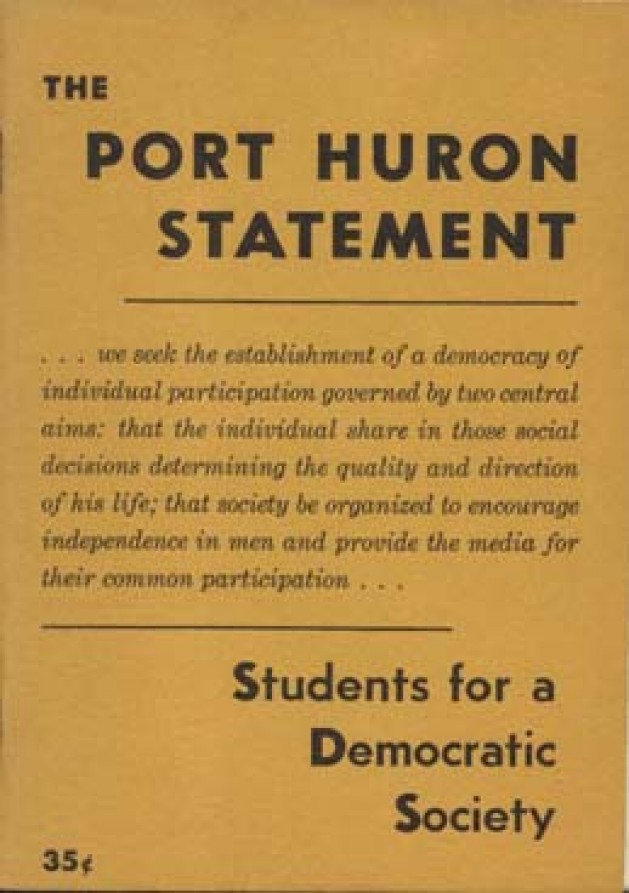
"We are the people of this generation, bred in at least modest comfort, housed now in universities, looking uncomfortably to the world we inherit" - Port Huron Statement of the Students for a Democratic Society, 1962

I was born in 1953 - just months after Dwight Eisenhower began his first term as President of the United States. My earliest awareness of politics came with the election of 1960. I was only seven years old and knew nothing of the issues of that day, but I liked John Kennedy. Compared to the grandfatherly Eisenhower, he was young and vibrant - from the same generation as my parents. I dimly recall that his election seemed to mark a new beginning - but I didn't know why. Growing up in Atlanta, I saw the separate drinking fountains and attended a segregated school (until the 6th grade) and even at that young age I had a sense that the treatment of African-Americans was brutally unfair. But I was a child and had only a child's perceptions of the world I lived in.

My memory of the Cuban Missile Crisis of 1962 is of my Mother telling me that we would have to watch the President speak on television one night to see if "the soldiers were going to go to war." My fear was for my Father; I was terrified that he was going to have to leave our home and fight. Fortunately was averted, although it was years before most people realized just how close we came to a nuclear confrontation with the Soviet Union.

The Kennedy Administration was, sad to say, all too short-lived. In November 1963, I was sitting in my fifth grade classroom when the school principal announced on the intercom that the President had been shot in Dallas. A few minutes later a second announcement came - the dreaded news that John F. Kennedy was dead. School was dismissed early and for the next four days I watched events unfold on my family's black and white television. I actually saw the shooting of Lee Harvey Oswald live on the news as our family sat eating lunch. My Father simply said, "My God." The whole world seemed to have gone mad in this terrible and frightening time that marked the beginning of the period we now call "the sixties."

Lyndon Johnson assumed office and immediately began to press for passage of Kennedy's Civil Rights legislative agenda. By the end of 1964, the Civil Rights Act was law to be followed the next year by the Voting Rights Act and the Social Security Act of 1965 which established Medicare, a cornerstone of Johnson's ambitious Great Society program. These accomplishments should have established the Johnson Administration as one of the great presidencies in American History. But, in 1964 another bill was passed which would overshadow LBJ's social agenda and eventually destroy his presidency: the Gulf of Tonkin Resolution which began the escalation of America's involvement in Vietnam. Over the next few years, S.D.S. and the student movement gradually refocused its attention from Civil Rights and Nuclear Disarmament to the organized opposition to the War in Vietnam and set the stage for the explosive events of 1968.

By 1968, Vietnam dominated the American consciousness, especially on college campuses. On the last day of January, the Tet Offensive began - which led to two key media events which would begin to turn American public opinion against the war. The first was the publication of the famous, Pulitzer Prize winning photograph by Eddie Adams depicting the summary execution of a Viet Cong officer by a Saigon police official. The second was the February report on the war by Walter Cronkite in which he declared his opposition to America's involvement in the war. One month later, Lyndon Johnson announced that he would not seek re-election and the race for the Democratic nomination became a three-way race between Hubert Humphrey, Eugene McCarthy, and Robert Kennedy.

Despite the focus on the war, the Civil Rights movement was still very active. Its primary leader, Martin Luther King had begun to expand his focus to broader issues, recognizing that people could not live in freedom when they were oppressed economically. It was that economic oppression that brought him to Memphis in early April to support a strike by African American sanitation workers. That work was brutally cut short when he was assassinated on April 4. I was in the ninth grade that year and was a member of my high school's tennis team. We were to have practice the next day, but it was canceled, not out of respect for Dr. King, but because of the rumors that there was going to be "trouble."

Two months later, I was camping out with two friends when a third friend came to visit us. He gave us the news that Robert Kennedy has been shot the night before in California. We were stunned - but not as much as one might think. to our young minds, this was becoming the status quo - people who worked to make a difference politically were (it seemed) routinely gunned down in the United States. I can't say that the event had any immediate effect on my political views; it was simply too commonplace then. It retrospect, the loss of Robert Kennedy was a turning point for me and for many. Even today - 43 years later - there are many on the Left who think his assassination changed the course of history. Would we have suffered through the Nixon presidency had Kennedy gotten the Democratic nomination that year? Would we have suffered through a thirty-year conservative reign later on? No one will ever know.

What did have a profound and immediate effect on my politics that summer was the police riot that occurred outside of the Democratic Convention in Chicago. The images on television were dreadful and there was absolutely no question which side I was on. I can say that my radicalization really began that week; it was then that I began to realize that the promises of American freedom of expression and the right to political dissent were not guaranteed by the political system. In fact, the political system seemed intent on suppressing those rights whenever it could. That, by the way, is still true to this day; the powerful corporate interests that control our nation are intent on using their resources to quash any action which threatens their power. More on that later.

In November of that year, my family moved to Pensacola. As I began to make new friends, I gravitated to students who, like myself, were sympathetic to the anti-war movement. Pensacola was (and is) a conservative town so there was very little in the way of organized protest in 1968. Over the next few years, that would change, however.

24 May 2010

O Lost

"O lost, And by the wind grieved, Ghost,
Come back again.
" - Thomas Wolfe

Commercial Television sometimes makes for too easy a target. Series abound with poor writing, hackneyed themes, and mediocre acting. The commercial medium presents a challenging structure: David Lynch described it as making a series of short, self-contained subfilms, 10-15 minutes long and separated by mostly annoying distractions. The requirement of high ratings exacerbates the problem as Americans are generally not overly sophisticated in their entertainment choices.

And yet - sometimes a project develops which is able to transcend the limitations of the form. Commercial television has seen its greatness - The Twilight Zone, The Prisoner, China Beach, The Wonder Years, Buffy the Vampire Slayer, and the re-imagined Battlestar Galactica (okay it was cable, but still had commercial interruptions) to name a few of the dramas. We can add Lost to that mix; for the past half-decade it has been the best thing on network TV. It had an ingenuous premise to be sure with all sorts of twists, turns, and clever cultural allusions. But ultimately, the great dramatic shows are about characters and JJ Abrams gave us some great ones. Last night's finale was a teary event - each realization/flashback reinforced our love for these characters. The episode was remarkably artifice-free, the writers simply gave us the straight story - no final twist or curve ball. All of our questions weren't answered of course (no one really expected that did they?) but we saw the people we have come to know and care about reach resolution and redemption.

Lost was ultimately about hope after all.

14 January 2010

RIP Teddy

Philadelphia soul never got any better than this.

23 October 2009

Sincerely, L. Cohen


We're so lucky to be alive at the same time Leonard Cohen is.
- Lou Reed inducting Leonard Cohen into the Rock and Roll Hall of Fame 2008

Another night, another capacity crowd, another standing ovation as the old man takes the stage. He humbly thanks the audience and then it begins:

Dance me to your beauty with a burning violin
Dance me through the panic til Im gathered safely in
Lift me like an olive branch and be my homeward dove
Dance me to the end of love...


The same song with which he began his shows the last time he toured - 15 years ago. His voice is rough and weathered and deep, and it fills the theater. After the ovation for the song, he removes his hat, holds it over his heart, and thanks the audience, telling them that "I don't know when we might pass this way again, but tonight we are going to give you everything we have." And for the next three and a half hours, that is what he and his compatriots did, giving the audience a 25 song overview of a career which has lasted more than 50 years (his first book of poetry was published in 1956). There were songs from every period; the setlist drew the most from 1988's "I'm Your Man" - featuring 6 songs from that album - but the material ranged from "Suzanne" and "Sisters of Mercy" right up to the sublime "In My Secret Life." All of this performed with a virtuoso band and vocal support from his long-time collaborator Sharon Robinson along with Hattie and Charley, the Webb sisters.

The high point of the show for many (I'm sure) was "Hallelujah" - perhaps Cohen's best-known song these days. And it was a stirring performance - reminding the audience that, while Jeff Buckley and Rufus Wainwright may have popularized it, Cohen owns this song and no one - no one - will ever sing it like he does. It was a great moment to be sure - but for me, the second encore (there were three) was the highlight with a sparse performance of "Famous Blue Raincoat," followed by "If It Be Your Will." The latter opened with a recitation by Cohen after which the Webb sisters sang the rest of the song.

So - the three hours plus was a gift from this great artist - poet, novelist, songwriter, Zen monk, performer, mystic - to the audience. It is likely that most of us will never again have the opportunity to see this music performed live: Cohen is 75 and one has to wonder if he will be able to mount an effort like this again. Sooner or later, the song will prove prophetic:

If it be your will
That I speak no more
And my voice be still
As it was before
I will speak no more
I shall abide until
I am spoken for
If it be your will


We are indeed fortunate to have Leonard Cohen: I have never seen a performer with such dignity, class, and humility, and genuine love for his audience. This was the concert experience of a lifetime for me and I will treasure the memory.

Photo credit: Robb Cohen

16 September 2009

Pawns in the Game


A South politician preaches to the poor white man
"You got more than blacks, don't complain
You're better than them, you been born with white skin" they explain
And the Negro's name
Is used it is plain
For the politician's gain
As he rises to fame
And the poor white remains
On the caboose of the train
But it ain't him to blame
He's only a pawn in their game.

- Bob Dylan "Only a Pawn in Their Game"

Former President Carter's comments with respect to race and President Obama's oppostion are, regrettably, dead on - at least in the South. This is not to say that all opposition (Southern or otherwise) to the Administration's policies is motivated by racism. Carter didn't say that; what he said was that the most vehement, hateful opposition had a significant racial component. Maureen Dowd wrote essentially the same thing in Sunday's New York Times.

Conservative officials send and forward ethnically-demeaning emails - pictures of watermelon patches at the White House, portraits of the 43rd President as a pair of white eyes in an otherwise black frame, pictures of the President dressed as an African witch doctor or as Curious George - the list goes on. Underlying the so-called birther's contentions regarding the President's citizenship is the bigoted fear of the other - the exotic - the foreign - the un-American. There are to be sure a number of Americans - and the vast majority of them are in the South - who simply cannot accept the fact that a non-white person could be the Commander-in-Chief. Not all southerners - not even most southerners. But they are there. Some of them I know - some I have known all of my life.

Glen Beck is probably the prominent journalist to flirt with overt racism - his accusation that the President "hated white people" was a play to those in his audience who wanted their own bigotry and hatred rationalized and made legitimate. Pat Buchanan writes longingly of the days when when Jeb Stuart and Robert E. Lee were viewed as heroes (instead of the traitors that they most certainly were), and laments that Dr. King and Cesar Chavez have taken their place in the American pantheon. Rep. Joe Wilson - with a history of association with neo-confederate organizations - shouts out at the President, "you lie" and those of us who know the South could almost hear the "boy" which would have followed in less august surroundings. And the weekend "Tea Party" demonstration in Washington, DC - which glorified the aforementioned Beck and displayed numerous racist signs and placards - resembled nothing so much as an old-fashioned lynch mob. The only thing missing was the rope - at least, I didn't see a rope in any of the pictures (there might well have been one there).

The election of President Obama has picked a scab from a national wound - and, while they will not outwardly condone overt racism, the conservative leadership recognizes the fact that bigots represent a small, but significant portion of their following. Their titular leader - Rush Limbaugh - has known this for years and racially-offensive humor has been a part of his routine from the beginning. Even the election of the embarrassingly incompetent Michael Steele to the RNC chair was little more than a callous and cynical attempt to cloak that aspect of the right wing. But - in the final analysis - the Republicans have only the White South remaining as a base - and they cannot afford to antagonize any of their remaining constituencies. So they don't.

Fueling the fire further is the demographic holocaust which is beginning to engulf the conservative movement. American whites are well on their way to minority status; this is the real reason behind the vitriol directed at citizens of African or Hispanic descent. Before all is said and done, Asians will likely join other non-white people as objects of suspicion. There are still some dark days ahead - but we recognize that these issues have to be exposed to the light of day. And the offenders will run from that light like the cockroaches they are.

11 September 2009


"I never meant to say that the Conservatives are generally stupid. I meant to say that stupid people are generally Conservative. I believe that is so obviously and universally admitted a principle that I hardly think any gentleman will deny it."

- John Stuart Mill

28 August 2009

The Morse Code of the Gods


That's what one reviewer called Hal Blaine's drum riff in "Be My Baby." Brian Wilson called this the "greatest pop record ever made." Certainly a lot of that had to do with the earth-shaking wall of sound that Phil Spector imparted onto this production (and many others in the early 60's). And then - there's Veronica Bennett (later to become Ronnie Spector) whose eyes and voice were, and still are, mesmerizing. Watch her as she sings the line "we'll make 'em turn their heads" - she was unearthly.

And the song. The song was written by Jeff Barry and Ellie Greenwich who passed away this week at the age of 68. Greenwich was one of the Brill Building songwriters and she wrote many of the true classics from this period: "I Can Hear Music," "Baby, I Love You," "River Deep, Mountain High," "Da Doo Ron Ron," "Chapel of Love," "Leader of the Pack" - an amazing body of work which literally defined the early girl group sound and formed the basis for the great mini-symphonies that Phil Spector created for Philles Records.

But it didn't get any better than this - "Be My Baby" is timeless and capable of inducing goosebumps nearly a half-century later. It is, in a word, perfect. RIP Ellie.